Tuesday, 16 April 2019

Lesson Learned - Hopefully

For me, one of the great joys in being a collector has been the learning opportunity that accompanies each and every acquisition. The knowledge so graciously shared by other collectors and experts has been invaluable as the collection grows along with my own expertise. However, I'm also guilty of being a slow learner on occasion, only advancing my knowledge as a result of the poor outcome of a particularly risky decision that I've made (usually pertaining to the actual condition of an item vs. the seller's overly inflated opinion of the "treasure" they're selling). While I have made my share of bad decisions over the years, only recently has the additional spectre of fakery & fraud crept into my current sphere of collecting.

Stories of fakes or frauds in the collecting world are not unusual, but I would never have thought that anyone would actually find it to be a worthwhile endeavour to create fake antique pen (nib) boxes and sell them as "sealed" (unopened) pen boxes... until now.
Contents are actually a mix of low value pens
Fake "sealed" boxes of pens


Other fake boxes


Some antique pen boxes are quite rare and can sell for significant sums of money, but the average box, including most, or all, of the original pens within, generally sells in the $20-$50 range. This is hardly the kind of financial return one might hope for when undertaking a completely illegal counterfeiting effort that consists of making replica boxes, and then filling them with actual vintage pen nibs (just not nibs that match the label on the box!). There is also the reality that pen box collecting is not exactly considered to be a major market opportunity. But apparently there are some folks out there that disagree, and I recently became aware of this type of fraud with my own collection.

I've been acquiring pen boxes for less than a year, and I consider myself to be a complete neophyte in terms of knowledge in this particular area (an earlier blog entry talked about a few of my early acquisitions - https://yorewrite.blogspot.com/2018/08/well-well-if-it-isnt-his-nibs.html).

So I was quite excited when I came across a posting in a collectors' forum offering a large number of vintage dip pen nib boxes and their contents for sale. The poster is well known as a writing equipment collector/dealer and these boxes had been part of a much larger acquisition. The poster's expertise and collecting interests do not include pen boxes so they decided to dispose of the boxes as a lot. This was a great opportunity for me to increase my pen box collection so I reached out to try and negotiate a purchase.

The only problem was that the seller had also just become aware that several of the boxes were fake. They very openly, and honestly, pointed this out to me after they'd opened a couple of the sealed boxes and discovered a range of less valuable mixed pen nibs inside that did not match the box labels. While the fakes resulted in several of the boxes now having no value, most of the lot was genuine. So, an acceptable price was agreed to and a package containing over 20 pen boxes from 3 different countries, over half a dozen different pen makers, and the efforts of one fraudster, arrived a couple of weeks later.

Some of the good ones
... and their contents
Now one might rightfully wonder what would possibly motivate someone (me) into buying fakes, knowing full well that they are fakes? The answer is simple really ... to learn.

Here was an opportunity for me to significantly reduce the potential cost of this particular learning experience as I already knew that several of the boxes were fake! If you need to, re-read that sentence; there is sound logic in there somewhere, I'm certain of it!

I regularly sell & trade items from my collection so that I can acquire other items that are of interest or simply to do a little "culling of the herd". Expanding my knowledge to include some of the bad stuff enables me to not only make the best acquisition decisions that I can, but also allows me to be as honest as possible when I present items for sale or trade.

What will happen with these particular items? Well, the fake boxes have been segregated and marked as fakes so that they can't be re-sold. Their contents (over 1,000 pen nibs) will gradually be sorted. I've already found several rarer pens among them, which raises another question as to why someone would fill fake boxes (that the experts can generally tell are fake without even opening the box) with a mix of pens that might actually have some value on their own. I may keep a few of the more interesting pens and then sell of the remainder to other collectors, calligraphers, or anyone that may be looking for a few hundred random vintage dip pen nibs.

So did I learn anything? Well I'd like to think so. The information provided by the experts and collectors within the online groups has been invaluable and I've expanded my awareness of the world of fakes. The individual that I interacted with in this transaction was extremely open and honest throughout the discussion, and what I received exactly matched what had been described to me (the good and the bad!). It is also a reminder that it's always ok to ask questions; there may be fraudsters out there, but there are also a lot of experts and experienced collectors that are are more than willing to help educate those of us that are still on the steeper side of the learning curve.

Most importantly, the good half of the acquisition has allowed me to significantly expand my collection of pen boxes and their contents and now I need to prepare the next drawer in the cabinet for their safe keeping .....


........

Saturday, 16 March 2019

The Well-Appointed British Walker of 1901


Several years ago, our daughter and son-in-law moved to a small community in the Lakes District in northern England. Our travels to the UK had previously consisted of a short trip to tour Scotland, and  another to attend our daughter's wedding in Cheltenham. Both of those trips hold great memories for us, but it was our visits to their home in the Lakes District that solidified our love of England and Scotland.

The beauty of the Pennines,  including Nine Standards Rigg, miles off in the distance on Hartley Fell, can be seen from their front yard, and the gorgeous vistas of Ullswater and Windemere are just a short drive to the west.

Front yard view of the Pennines
Ullswater
Nine Standards Rigg
On our very first visit we noticed large numbers of people out walking, everywhere! The community where our daughter was living was located along the Coast to Coast "Walk", just one of countless walking paths in the area. We soon discovered that walking is a serious pastime in this part of the world and over the years we've enjoyed a good many walks with the family.

All of which led me to wonder about the origins of this oddly intense and widespread desire in the UK to go for a "walk", no matter the weather conditions. The climate in that area can often be quite pleasant and inviting; however it seemed to us that just as often there would be hours, or days, of unrelentingly foul, dreary, wet, and occasionally frigid, weather conditions, and yet the walkers were ever-present (including ourselves).

A cold, puddle-jumping, stone circle walk at Castlerigg
A cool, pleasant day for a Pennines walk


It turns out that the majority of the credit for popularizing this sometimes odd behaviour belongs to an 18th century Jesuit Priest named Thomas West. Well travelled throughout Europe and the Lakes District, he eventually settled in Furness, and decided to write a guide book for the area. "Guide to the Lakes", was published in 1778 and became a major success, with 7 editions being printed before the turn of the century. Thus began Lakes District walking tourism, and the rest is walking history...William Wordsworth, Alfred Wainwright, and many other writers, followed, but it was Tommy W. that first made the idea of simply walking for pleasure a "thing".

The walkers of today's England, whether out for a casual Sunday afternoon trek, or a 7 day walk along Hadrian's Wall, are all equipped in similar, if more modern, fashion to their Victorian ancestors, with a variety of gear to suit the particular walk they've undertaken; day pack or overnight backpack, food, water, proper hiking boots or good trail shoes, light windbreaker, or full-on rain/all-weather gear, etc. 

One of the more noticeable differences between the modern and the late-Victorian walkers would be today's omnipresent cell phones that virtually all walkers have with them. It serves many purposes as a walking "aid" - as a phone of course, should calling for help become necessary, but also as a camera, a gps/mapping device, a timepiece, and even a place to record field notes. 

And absent of a cell phone, what special equipment did the well appointed walker of the late 19th / early 20th century have? ... 

Why, a pencil of course!

But not just ANY pencil... those that could afford it might carry something like this one with them; an exceptional "companion pencil" dating to 1901 and made by London silversmith William Hornby. 
1901 Companion Pencil - William Hornby
Recently acquired from the KB Collection of Pencils (shown on page 75 of the book), this sterling silver companion pencil includes three different coloured pencils, a compass, a whistle, AND a sun dial. At just 8cm (3") in length and 2cm (.75") wide, it allowed walkers of that era to accomplish many of the same functions as our phones offer us today...

Lost? - Compass
Need help? - Whistle

Time for lunch? - Sun Dial
Sketch a memory or take notes


Most of my rarer pencils date to the early to mid-1800's but this one was so unique and in such exceptional condition that I couldn't resist. It is fully hallmarked (in two locations) for William Hornby, London, 1901. All three of the pencils are fully functional and are extended by using the enamelled slider buttons. The compass is inset into the pencil within a band of gold. and is still working. The whistle and sun dial flip open from the back. The whistle has a small protective cap of silver. The sun dial is probably the most unique feature. When the whistle cap is removed there is a tiny "v"notch at the open end to catch the sun's rays. Calibrated at 51 degrees north (as marked just under the "v"), this corresponds to London's latitude. It can be suspended from an Albert chain using the the swivel and ring located at the top.

"I'm just going out for a wee walk dear..." "Well don't forget your pencil..."


Sources : Wikipedia - Walking in the United Kingdom

Wednesday, 13 February 2019

The Three Musket Tears

I almost shed a few wee happy tears yesterday when the first of my recent KB Collection auction purchases arrived, which included three musket pencils. The three were sold together as a single lot (an "all for one, one for all" kind of thing I suppose). I hadn't really intended to bid on this particular lot but one of the pencils was a design by a British maker that I had been looking for for some time. So I threw in a low ball bid... and they threw back an invoice...

The first two pencils are unmarked and made of electroplated base metal or German silver. They would have been made as a bit of a novelty item in the mid-1800's. These two rifles each have a pencil, a toothpick, and a dip pen built into them.

But it was the 3rd pencil that had my attention. It is also German Silver, and made by Josh Baker. The imprint on the lower barrel is "JOSH BAKER NO 1166 4 APR 184". That would have been "1842" at the end but they ran out of room on the barrel when this one was stamped. This one has a pencil and toothpick but no dip pen. It is 8.5cm (3.5") closed and 10.5cm (4") when the pencil is extended.

1842 Josh Baker Novelty Pencil

 
After spending hours trying to find out more about Josh Baker, I had all but given up when I found an entry in "The Practical Mechanic and Engineer's Magazine" of 1842 attributing design #1166 to "Joseph Baker", not "Josh Baker". So now I have two names, Josh & Joseph. The barrel of the piece is clearly "Josh" and the design registration is clearly "Joseph". Could it be a typo in the registry, or second "Baker" that is part of the business? So far I've been unable to find out where in England they were made, or whether Baker made any other pieces. The search for clarity continues.

And now that I think about it, perhaps those weren't happy tears... my watery eyes may have been a result of having received the credit card bill for the auction purchases on the same day as the shipment of pencils ...


Sunday, 10 February 2019

Signed, Sealed, Delivered

I suspect that few of us that are currently alive in the 21st century have received a letter or document in the mail that has been sealed by anything other than the gum on the envelope flap. The first machine made envelopes only appeared in 1845, when a patent for the mass-production of envelopes was filed by Victorian postal official Edwin Hill, and astronomer/inventor Warren De La Rue. Pre-gummed envelopes didn't make their first appearance until almost 50 years later.

Envelope Making Machine of Hill & De La Rue
Hill & De La Rue Display at 1851 Great Exposition


Prior to pre-gummed envelopes, starting in medieval times, the wax seal was commonly used. Early on, the "wax" was a mixture of about 2/3 beeswax and 1/3 resin but the mixture gradually became mostly resin, allowing, among other things, a variety of colours to be produced. The use of wax seals significantly increased in the mid-Victorian era as the reading and writing skills of the general population also increased. An additional factor during this period was that the cost of postage was determined by both the number of pieces of paper used, and the weight, so wax seals became a common way to reduce the weight. The seals used varied from larger handheld seals, to signet rings, and even ... attached to pencils.

Here are a few examples of pencil seals...

S. Mordan Makers & Patentees - This gold pencil dates between 1837 & 1844. The intaglio seal represents a British Fox Hound carved into a white quartz capstone. The actual seal is a mere 8mm (5/16") across which shows how finely detailed some of these hand-carved seals are.

English Fox Hound
English Fox Hound Wax Seal


Mordan Makers & Patentees - 1837-1844

S. Mordan Makers & Patentees - This silver pencil dates between 1837 & 1844. The intaglio seal represents two hands supporting the world, carved into a quartz capstone. The seal is 8mm (5/16") across.

Globe & Hands
Globe & Hands Wax Seal


Mordan Makers & Patentees - 1837-1844

S. Mordan & G. Riddle - This silver pencil is stamped "S. Mordan & Co's. Patent", and hallmarked "SMGR", London, 1826. The intaglio seal represents an image of a fly under the word "VITE" (Quick) carved into a bloodstone capstone. The seal is 8mm (5/16") across.

Fly "VITE"
Fly "VITE" Wax Seal
S. Mordan & Co's. Patent - 1826

Once pre-gummed envelopes appeared, the use of seals quickly declined and during the 20th century they were mostly relegated to use on legal and ceremonial documents. As we continue into the 21st century there is a small resurgence in handwritten correspondence and the use of personal seals is likewise enjoying a bit of a comeback. So there is still hope that one day I'll actually receive a letter sealed with wax.

Sources:

Friday, 25 January 2019

The Post Office

A collection of Victorian and early 20th century writing equipment wouldn't be complete without at least a minor nod to some of the other interesting items associated with the written word during that period.

In my collection, one such minor nod includes a couple of early 20th century Canada Post items. I am honestly trying to restrain myself when it comes to "minor nods" such as this, but those that know me may be inclined to suggest that I try harder, as when it comes to collecting & collectors, a "couple" of anything can easily become another rabbit hole that quickly leads into a whole new warren crying out for further exploration ...

According to Wikipedia, the first known international letter sent from what would, over 400 years later, become part of Canada, was sent in 1527 from St. John's, Newfoundland to King Henry VIII of England. The first known paid mail delivery within Canada took place in 1693, and Canada's federal postal service began just after Confederation, in 1867.

Canada Post Scales - Pritchard & Andrews, Ottawa
This Canada Post scale set dates to the early 20th century, and was made by Pritchard & Andrews, of Ottawa. It would have originally had a beautiful finish of glossy black paint with gold trim (only tiny fragments of which remain due to a rather harsh life over the last century). It would have been a beautiful looking piece in its day, with the black and gold of the centre stand and arms complemented by the gold tones of the solid brass scale pads, suspension chains, and weights. The weights are in ounces - 8, 4, 2, 1, & 1/2. Every major piece of the set is individually stamped "Canada P.O."


Postage Canceller - Monticello
A few weeks after obtaining the Canada Post scales, my wife handed me a small bag containing a postage canceller and an assortment of 40 metal date stamps that went with it. The canceller was from the Monticello General Store and Post Office in Monticello, Ontario. For over 35 years, from 1931 to the late 1960's, my wife's grandfather owned & operated the Monticello General Store (& Post Office). She had been given the canceller almost 40 years ago, following her grandfather's passing, and it has lain in a drawer, mostly forgotten, ever since.
These two simple items remind us of a time before the automation of the postal service, where the service provided was entirely done in person, and by hand.

Wednesday, 5 December 2018

Great Oaks From Little Acorns Grow

The mighty oak has been around much longer than we humans have, so as obvious as the title statement may seem, it apparently wasn't until the 14th century that someone decided that it should be recorded as a proverb. Since then we've attached a great deal of symbolism to the oak tree, and its humble beginning as a tiny acorn.

During Victorian times acorns were considered good luck charms, and also represented youthfulness, strength, and stability. Acorns were just one of many special symbols of the Victorian era that were represented in various novelty forms of the period, including pencils.

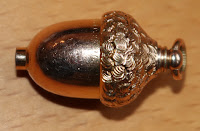
My collection includes a few lucky nuts; a tiny walnut pencil (made from an actual walnut shell), and several acorn pencils. Two of the acorn pencils stand out for a few reasons; they are gold, they have some interesting imprints, and both are exceptionally tiny as they are the size of real acorns when closed (approx. 2.5cm / 1") and just over 5 cm / 2" when extended.

The first one is a W.S. Hicks gold acorn magic pencil. While it doesn't have Hicks' name on it, there is an imprint on the side of the nut casing - "Pat. Sep. 25 77", which is the date associated with the Hicks U.S. Design Patent # 10,260.

The tip on this one needs to be replaced but otherwise it is in good working order in terms of extension/retraction and the lead advancement mechanism.


The second acorn is more intriguing. It is imprinted "L.W.F." for "Leroy W. Fairchild", another American maker and a contemporary of Hicks. Side by side, these two acorns appear  to be almost identical twins. The most noticeable differences are that the Fairchild barrel is a little shorter and stubbier than the Hicks, and the engraving on the cap is more detailed on the Fairchild.*


In addition to the "L.W.F." maker imprint, there is a British design lozenge indicating that the design patent was granted on the 28th day of September, 1877. So far my searches have failed to find out who the holder of that design patent was. However, the barrel is also imprinted with "Pat. Sep. 25 77", which refers to the American patent belonging to W.S. Hicks. While Fairchild was prolific in filing his own patents, he did not have one filed on that date, and both the design and patent of this pencil clearly belong to Hicks.


The presence of the design lozenge suggests that Fairchild made this for export to the U.K. The use of the Hicks patent date may have been done with Hicks' blessing but it may be just as likely that Fairchild simply stole Hicks' design and imprinted the barrels of his pencils with his own initials, and the Hicks patent date assuming no one would care. **

At this point, the information that I have on Leroy W. Fairchild is somewhat limited but my collection includes a number of other Fairchild pencils and pen/pencil combos that have patent dates imprinted on the barrels belonging to patents owned by a variety of other makers. He is the only maker I've come across that seems to have done this on a regular basis, and the logic behind it escapes me. More digging is required...

Additional Information Since Posting (see asterisked items above) :

* So here's a wacky theory - if we assume that the makers used actual acorns as "models" when designing these pieces, one could surmise that the Fairchild was fashioned after the American Red Oak acorn (short & stubby) and therefore made in America and imprinted with a design lozenge for export to the UK. The more elongated one, with just the Hicks patent date on it, is of similar shape to acorns from the English Oak tree. So perhaps... this one was made in the UK (Hicks did have locations in both New York & London), for the domestic UK market. Maybe...?

** David Nishimura (Vintage Pens) kindly shared some of his expert knowledge on how the LWF imprint combined with a Hicks patent date could have occurred. Apparently, during this period, it was common for makers to license other companies' patents. David indicated that the Fairchild acorn may have been manufactured under license this way, or could even have been made by Hicks but stamped for subsequent retailing by Fairchild. Cooperation amongst competitors was common, and there is no evidence to suggest that patent infringement ever took place.


Friday, 23 November 2018

Old is Old, But Black is Gold

... at least it is to me...

In a much earlier Blog entry I wrote about Charles Goodyear and a few of the pencils in my collection that had casings made from his patented vulcanized rubber (also called black hard rubber, BHR, or ebonite). One of the downsides of rubber is that it naturally oxidizes, with heat and light being the two main culprits when it comes to the oxidation of the rubber.

And for collectors like me, who prefer to have their items on display and looking much like they did when their original owners were using them, rather than hiding them away in a drawer, that means that some of these old ebonite pencils and combos eventually start looking a lot more like their current owner (grey and weathered) than they should.

I currently have over 20 BHR pencils and combos, and about half of them are looking a little rough as a result of oxidation. I recently began looking into options to revive the rubber a little and after some discussion with Mark Hoover, a fellow collector and owner of La Belle Epoque, I purchased a tube of Mark's "Restoration Balm".

I received the balm in the mail this morning and spent a couple of hours this afternoon working on two of the BHR's - a W.S. Hicks magic pencil, and a John Hoagland combo. I'll let the following images speak for themselves with regards to the effectiveness of Mark's product ... but let me just say in advance ... Thanks Mark!

John Hoagland Combo Pencil/Pen - There is no discernible maker's mark on this combo, but it does have a nice John Hoagland #4 nib. Once I cleaned up the BHR, I spent a bit of time on the gold fittings as well.


W.S. Hicks Magic Pencil - While the Hicks name is not present on this magic pencil, it does have a telltale indicator imprint - "Pat. March 21 '77", which refers to U.S. Patent 112,917 filed by William S. Hicks on March 21, 1877. Also imprinted on the barrel is a very faint A.G. Days patent date of August 10, 1858. Austin Goodyear Days patent was for “improvements” that he made to Goodyear’s 1851 patent. He was a cousin to Nelson Goodyear.


Now I just need to find the time to work on the remaining 20+ BHR's...