Monday, 20 November 2017

This Little Piggy

Like every generation before it and since, most of our Victorian ancestors lived according to the societal norms and "rules" of the day. Unspoken rules governed everything from one's place in Victorian social circles, to fashion, etiquette, the type of work available, and even the level of education that one had access to. While this era may be viewed as being extremely conservative by today's standards, it was also a time of great societal change.

Mechanization was changing the workforce, education was gaining importance throughout all levels of society, a "middle" class began to form, science was becoming a "thing" that everyone was excited about, and towards the end of the Victorian era the population as a whole was gradually loosening up on their conservatism... at least a little.

This loosening up impacted the late victorian lifestyle in many ways including fashion. Quality jewelry became appealing to a much wider population; it became more affordable, and much more widely available. While proper etiquette demanded that one be conservative in the display of jewelry, the loosening of the rules allowed one to be a little flashy without actually crossing the line.

For men during this period, the lowly watch chain became an agent of change. A watch chain was an acceptable piece of male jewelry for obvious reasons. In addition to securing one's pocket watch, the chain gradually began to be used for other subtle displays of one's wealth. Fobs would be added that were wax seals, toothpicks, watch keys (winder), and even pencils. These tiny, figural "charm" pencils were made in a variety of materials including gold and silver, and in many styles and shapes, including animals.

Pig - Sampson Mordan - c1875 - Victorians considered pigs a good luck symbol and I'm sure that this little little guy brought its owner plenty over the years. Just 1.25" when closed, it balloons to a whopping 3.25" when fully extended. Sterling silver, and made by S. Mordan, London, U.K.


Horse - Edward Todd - c1890 - This little horse head pencil was made around 1890 by American pencil maker Edward Todd. It is 1.5" when closed, and 3.0" when opened. Sterling silver, ruby eyes, with the Edward Todd symbol stamped on the inner barrel.


Owl - William S. Hicks - c1871 - The owl, symbol of wisdom. What self-declared genius of the late 19th century wouldn't want one of these on their watch chain? Made by W.S. Hicks of New York and stamped with "Pat. March 21, '71" which corresponds with Hicks' U.S. patent # 112,917 This little pencil is 1.25" when closed, and 1.75" fully extended.


Bull Dog - Unknown Maker - c1890 - Dogs represented loyalty, and this little pencil may have originally been given as a gift in that context. The quality is quite similar to that of the Hicks owl pencil above, and also has ruby eyes. It was most likely made by an american pencil case maker. The pencil is 1.25" long when closed, and 1.75" when fully extended.


Sunday, 1 October 2017

Word of the Day - Nacre

Nacre (noun: pronounced "NAY-ker") - otherwise known as mother-of-pearl.

While the inner barrel and mechanisms of most 19th century mechanical pencils were constructed of brass, it was the beauty of each pencil's outer coverings that would capture the attention of the consumer and help to encourage the separation of hard-earned savings from one's wallet or purse.  Pencil makers of the 19th century experimented with a variety of eye-catching coverings for their writing implements and one of these was mother-of-pearl.

E.S. (Ephraim) Johnson, of Jersey City, New Jersey, was the first pencil-case maker to patent a method for applying mother-of-pearl slabs to pencil barrels.
The technique that Johnson describes in his 1871 patent was to make the inner brass barrel polygonal, creating flat panel sides to which the mother-of-pearl slabs could then easily be applied.


In 1881, Lewis P. Warth, of New York, New York, was granted a patent for an improvement to the technique for applying mother-of-pearl to pencil barrels. The main difference between the two patents seems to be that Warth utilized a round barrel (not polygonal). The mother-of-pearl panels were then bonded to each other and not just to the barrel.

Warth assigned his patent to Frederick Julius Kaldenberg, also of New York. Kaldenberg was part of the F.W. Kaldenberg & Sons Company, one of the largest meerschaum pipe carvers in the U.S. at the time. Why a pipe manufacturer would wish to acquire a pencil-case related patent is unclear.

Both Johnson's and Warth's/Kaldenberg's techniques appear to have been utilized by a number of different American pencil-case makers of the period. Some pencils may have both the maker's name as well as one of the Johnson or Warth patent dates and others may have only the maker's name, or no markings at all. Here are a few from the collection ...


William S. Hicks - Mother-of-Pearl and Abalone Magic Pencil -The panels of mother-of-pearl and abalone would have been applied to the barrel and then the barrel turned in order to produce a nice smooth, rounded feel to the barrel. The pencil is 2.75" when closed, and 4.75" when fully extended.  While Hicks' name is not on the pencil, the gold base of the pencil casing has the Hicks patent date of March 21, 1871.

Mabie Todd & Co. - Mother-of-Pearl Magic Pencil - This Mabie Todd pencil would likely be a decade or so newer than the Hicks pencil above as its barrel includes the maker's name as well as "Pearl Pat MCH 8 81", which is referring to the Warth/Kaldenberg patent. This pencil is also 2.75" closed and 4.75" when fully extended.
Aikin, Lambert, & Co. - Mother-of-Pearl Magic Pencil - This little pencil would date to around 1870-1885. The barrel is imprinted with "Aikin, Lambert & Co". James Aikin and Henry Lambert were New York jewellers that had become partners following the civil war to try and get in on the growing pen industry. In addition to their pens & pencils, they made gold pen nibs and became a supplier of nibs to Lewis Waterman. In the early 20th century Waterman took over Aikin, Lambert. The pencil is 1.75" closed and it doubles in length to 3.5" when fully extended.


Unbranded - Mother-of-Pearl with Gold Bands Magic Pencil - The barrel on this one is comprised of alternating bands of mother-of-pearl and gold panels. It is just slightly smaller than the Aikin, Lambert pencil above. There is no maker's name on the pencil but the quality is similar to those above.


So there you have it... some great little mother-of-pearl magic pencils, and a new word....nacre...


Thursday, 21 September 2017

Beer and Pencils

As a collector it can be difficult to stay focussed in one specific collecting area without eventually coming across something that nudges you into making a slight detour before getting back on track. While the main focus of my collection is victorian era writing equipment (ie. pencils, pens, inkwells),  I have on occasion succumbed to the lure of writing equipment from more recent times. The usual thought process involved goes along the lines of - "Hmmm, it's not 19th century but it really looks interesting!", or "Crap, I must be old 'cause I remember those, I think I'd like to have one!" This particular detour has to do with beer ... and pencils.

During the 1940's-1960's the now ubiquitous ballpoint pen had not yet found its footing in society and the lowly mechanical pencil was still a very common portable writing instrument. Companies of the day resorted to a variety of advertising techniques to help raise brand awareness, one of which was to produce pencils that promoted their products in a way that was memorable, and quite often a little corny or tacky (in a clever, 50's kind of way).

Here are a few beer related pencils from that period...

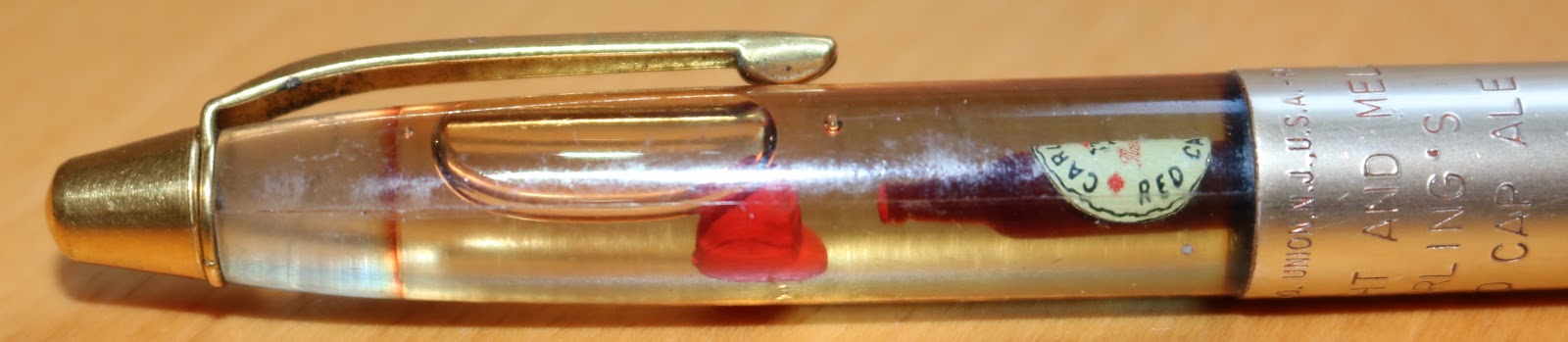
Carling's Red Cap Ale - This is one of my favourites.  The Carling's Red Cap television ads were always pretty cool when I was a kid (here's one of them). This "Red Cap" floater pencil has a tiny beer bottle and a tiny red hat that is intended to be a simple game of landing the hat on top of the bottle. The pencil was made by the Secretary Pen Co. of Union, New Jersey. The barrel is inscribed "Try Light & Mellow Carling's Red Cap Ale".

Ballantine's Export Beer - Around the time when this pencil was made, Ballantine was the #3 selling beer in the U.S., and they were also the first company to become a television sponsor of the New York Yankees. As the American desire for lighter lagers gained ground, the Ballantine brand slowly disappeared. More recently, Pabst reintroduced a Ballantine IPA as their entry into the craft beer market. This floater pencil has a ring toss game in the upper chamber, consisting of a miniature bottle of Ballantine's Export, along with 3 tiny red rings. The pencil was made by the Progressive Pen Co. (which was apparently the same company as Secretary Pen Co.). The barrel is inscribed "Wilsbach Distributors, 7th & Maclay Streets, Harrisburg, PA."

Coors Beer - The Coors floater pencil was made by Ritepoint, and is a decade or two newer than the two above. The barrel is imprinted with the Coors logo, along with "Brewed with Pure Rocky Mountain Spring Water". The miniature bottle of beer is actually filled with liquid.


Mid-20th century advertising pencils are fairly common and they are generally quite reasonably priced as a collectible. Although they don't have the same level of appeal to me as the much earlier victorian pencils do, they still regularly find their way into my collection, as I'm sure will become evident in some future blogs.

Monday, 11 September 2017

Instant Success Takes Time

It is said that "instant success takes time", and a perfect example is the development of the "Stanhope" viewer.

The story of the stanhope begins with the 18th century British statesman and scientist, Charles Stanhope, 3rd Earl Stanhope. Among Lord Stanhope's accomplishments was the invention of a simple, small, one-piece microscope that could be handheld for up-close viewing. The Stanhope Lens became quite popular during the 19th century with a variety of applications, including medical.

The next major contributor to the stanhope viewer story was John Benjamin Dancer, maker of scientific instruments and inventor during the mid-19th century. In 1851 Dancer invented microphotography. His tiny images attracted a great deal of public interest, however, the downside was that in order to view Dancer's images one needed to own, or have access to, a microscope, which were quite an expensive item at the time.

In 1857, some of Dancer's micro images were displayed in Paris, where the French photographer and inventor René Dagron immediately saw their potential. By 1859, Dagron had come up with a modified version of the stanhope lens, with microphotographs attached directly to the viewing lens. He also obtained the first microfilm patent that year and began manufacturing a wide variety of jewellery, toys, souvenirs ... and pencils ... containing stanhope viewers and images. Dagron's Bijoux Photomicroscopiques were so popular that by 1862 he employed 150 people and his factory was producing over 12,000 units per day! The "instant success" of the stanhope was actually almost 100 years in the making.

The subject matter of the micro images covered a wide range of topics. Religious imagery was extremely popular; travel souvenir stanhopes showed photographs of towns and popular landmarks; and of course quite risqué (at the time) stanhopes were widely available among "men's accessories" as well.

Dagron's factory continued producing stanhopes using his methods right up until 1972. Although not nearly as popular as they once were, stanhopes are still being produced today. Among the wide range of options available, you can even have your own custom stanhope pencil or pen created just for you.

Here are a few examples of my stanhope pencils ...

Wooden "Spotted Egg" Stanhope Pencil - This one is from around the end of the 19th century, or very early 20th century. The "egg" is wood, with spots added for "realism". It was made as a souvenir and contains a stanhope with 4 different views of "Sudbury from the Misses Parsonson's Bazaar" in the UK.

If you look closely at the image on the left you can see the actual stanhope image inside the lens. That dark little spec in the middle of the lens contains 4 individual photos plus text (the lens is just 2 mm (0.078 inches) in diameter ... in other words ... very small!). The last photo shows a portion of the actual stanhope image (it's not as blurry when viewed directly through the lens).

Metal Souvenir Stanhope Pencil - A rather plain little metal souvenir pencil from about the same period (early 20th century) showing 6 images - "A Memory of Seaton", also in the UK.


Mid-20th Century "Peep Show" Pencil - While I have yet to find any victorian era "peepers" for the collection, I do have this 'bikini model" example from the 1950s or 60's that would likely have been given out to customers in the construction business by this New Jersey contracting company.

My photos of the micro images are not of the highest quality and certainly do not reflect the quality of the actual stanhopes which are generally quite clear and detailed. To properly photograph these tiny images requires much better equipment (e.g. a microscope with camera attachment) and much more time than I was prepared to invest.
That said, I'm fairly pleased with the results given my home-made lens "adaptor" - a canning jar lid with a 2mm hole drilled through it and black electrical tape to hold it to the camera and block out extraneous light. Using this fine piece of equipment, and a somewhat steady hand to hold the stanhopes against the hole while simultaneously adjusting zoom & focus, and clicking the shutter, and ... voila! Take that René Dagron!


Tuesday, 29 August 2017

"Chance Favours the Prepared Mind"

This has been one of my favourite quotes for many years now. While the quote is attributed to Louis Pasteur in 1854, I first heard it from a National Geographic photographer explaining to his audience how he managed to get this one particularly spectacular shot. For me, the quote beautifully sums up a strategy applicable to many aspects of life, including collecting!

When I first began collecting pencils, I would often purchase "lots" whenever possible, simply to expand the collection quickly. As I gained experience I quickly realized that vendors selling  multiples of an item were often cleaning out their own collections of the less desirable, or non-functioning, pencils. Since then I have generally only purchased pencils one or two at a time, and only when a good description and clear photos are provided.

However, the appeal of buying several pencils at a time is still there. Sometimes "lots" include hidden gems that the seller is unaware of and occasionally the desire to bid on a pencil "lot" bubbles to the surface when I think I see something in the photos that the seller may have missed. Such was the case recently when I purchased a "lot" of 7 pencils from an online dealer.

The description indicated that 2 of the pencils were made by S. Mordan and that attracted my attention initially.  As for the remaining 5, the description simply indicated that the makers were unknown but that they were in good condition. The photos suggested a different story, so I decided to take a gamble as the Mordans alone were worth the final price paid. Once they arrived and I was able to examine them more closely, under the loupe. I was able to confirm my initial suspicions and have now happily added  4 of the 7 to my collection...

The first of the 4 "keepers" is a very nice Mordan combination pencil/pen, full hallmarked for London, 1900.

It is in near mint, working, condition.


The second is a small silver and gold magic pencil, just 1.5" long when closed, and 3" when extended. The combination of silver & gold isn't often seen, which appealed to me, and the photos suggested that it was in excellent condition.

The excellent condition of the pencil was confirmed when received, but the more pleasant surprise was seeing that the upper barrel had been stamped "LWF & Co".

Leroy Fairchild was a 19th American pencil case maker (New York) and his pencils were generally higher quality and well made. The variety of his offerings in terms of pen and pencils was arguably as broad as that of Sampson Mordan and this is a nice addition to the variety of Fairchild pencils, combos, and figurals already in the collection.

The last two pencils also had identifying marks on them, and both are the first pencils from those makers that I have been able to acquire.

This magic pencil was made by John Knapp of New York. It is 2.75" when closed and 5" when extended.
While his name isn't on the pencil, the upper barrel is stamped "Pat. Feb. 6 '72". This patent date is tied to two pencil-case patents filed by John Knapp on that date - #123,485, and #123,486.

Patent 123,485 was the specific patent that applied to the design of this pencil.


Pencil #4 is a bit of an odd duck, and likely requires more research before I can determine the actual maker with more certainty. It is a tablet style pencil; a full 6" in length. Examining the barrel under the loupe I was able to make out "Drew & Sons Piccadilly Circus W". After a bit of digging I was able to determine that John Drew founded the company in 1844, with his sons Samuel and Ernest eventually taking over. The company was known as a supplier of high-end gentleman's accessories, including items such as cigar cases, picnic baskets, flasks, luggage, and ... pen sets.

The company remained in business until the mid-1930's and was located at Piccadilly Circus from 1887 to 1914. These types of high-end retailers often had specialist firms (such as S. Mordan) manufacture the items which were then branded with their own company name (as many retailers still do today).

The remaining 3 pencils will be sold at some point (including the 2nd Mordan which was not a desirable design) and the 4 pencils now added to the collection are worth far more than the price I paid for the entire "lot".

This time, with a lot more experience, and by being cautious up front, the bulk purchase approach paid off - sometimes chance DOES favour the prepared mind...

Tuesday, 15 August 2017

A Prickly Business

While many of the upscale Victorian pen/pencil case makers in England used silver or gold for the majority of their pen/pencil casings, these same makers regularly experimented with, and offered finished products with, cases made of other materials. One of the more peculiar casing choices used at the time was the porcupine quill. There is a species of porcupine in Africa that has quills that can be over 30 cm long (one foot+). At some point African porcupine quills found their way to Great Britain, perhaps as souvenirs, or perhaps embedded in the backside of one of Great Britain's intrepid explorers of the day. An enterprising soul eventually noticed how these quills were quite similar in size to existing pen/pencil barrels, and a new, creative option for pen/pencil case makers was "discovered"...

Two of the porcupine quill writing implements in my collection are pencils, while the third is a dip pen, and all three date to around 1880. The dip pen was made by Sampson Mordan (the sterling silver ferrule is stamped "S. Mordan & Co."). The overall length of the pen is 23 cm (9") and the quill measures a healthy 18 cm (7").


The smaller pencil was also made by Sampson Mordan ("S. Mordan & Co. is stamped on the cap). It is quite tiny compared to the dip pen; just 6.5 cm closed and 9 cm when fully extended (2.5"/3.5").

The second pencil is the rarest of the quill pencils, being a triple-barrelled slider pencil. It does not have a maker's name but is a very similar design to a 3 barrelled pencil made by Mordan.
The quills have been cemented together and the cap and pencil tip are both sterling silver.

It is 8 cm long when closed and 10 cm long when extended (3.25"/4.0").


Porcupine quills have traditionally been used for a great variety of purposes and they are still widely used (there are many sources of both North American and African porcupine quills on the internet for those in need), but as far as I have been able to determine, their use as pen/pencil case barrels was fairly short-lived. I suspect that the quills simply did not stand up to the rigours of daily use and abuse.


Sunday, 6 August 2017

The Patent Perryian Gravitating Inkstand

James Perry was a schoolmaster in Manchester during the early part of the 19th century. Around 1819 James worked out a steel pen design that provided better ink flow and flexibility than was previously available with existing steel pens. While steel pens had been around for quite some time prior to James' new pens becoming available, the quill was still the favoured writing instrument due to the frustrating limitations of the steel pens available at the time.

He initially began making these steel pens as rewards of merit for his students, and by 1824 James and his brother Stephen had started their own business making and selling steel pens. The business grew rapidly and soon their stationery and related product offerings included pens, propelling pencils, inks, inkstands, and a wide variety of other items.

Perry & Co. continued to expand, eventually having offices in London, Brussels, Amsterdam, Frankfurt, and New York. When James died in 1843, the business was carried on by Stephen. What began as the result of one person's simple desire to improve the writing experience of his students, turned into a major enterprise that ultimately lasted well into the middle of the 20th century. At one time or another Perry & Co. produced and/or sold everything from steel pens to general office supplies, and bicycle chains to actual cars.

The 1883 Perry & Co. Illustrated Price guide (available online thanks to Google) provides an amazing look at the breadth of products that Perry & Co. had on offer at the time .

The "Patent Perryian Gravitating Inkstand" appears to have first come on the market around 1842. While I haven't found the actual original "patent" for the inkstand, the first advertisement (complete with testimonials) that I found was in Bent's Literary Advertiser for January to December, 1842.


The ceramic cylinder could be filled with ink, and when not in use it could be rolled upwards and "locked" in place by a small brass wedge that slides under the cylinder. The novelty of the inkstand was that this action allowed the ink to be protected from dust and from evaporation between uses.


A clever design in its day, with an equally clever product name that just sort of calls out to you, and subconsciously you suddenly find yourself "needing" a Patent Perryian Gravitating Inkstand; at least that is my explanation for how this one recently became part of the collection.

